On July 7, Zimbabwe's President Emmerson Mnangagwa signed Constitutional Amendment No. 3. It lengthens presidential terms from five years to seven, moves the choice of president from voters to a joint sitting of parliament, and increases the Senate from 80 seats to 90, with 10 appointed by the president himself.
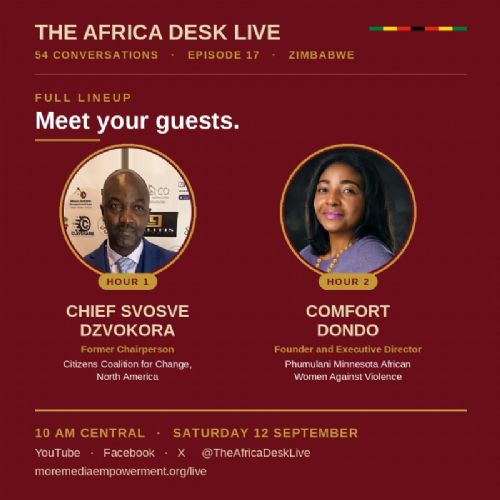
"That's not what we fought for," Chief Svosve Dzvokora told The Africa Desk Live on September 12. One person, one vote was an ideal of the liberation struggle, he said, and the people who died for independence died so that Zimbabweans could elect their president directly.
The episode, the 17th in MORE's 54 Conversations series, opened with a reminder of the stakes. Two days earlier in Masvingo, host Semantics King Jr. told viewers that Mnangagwa had told a laughing crowd he would still be around in nine years.
A chief who declined the chieftaincy
Dzvokora is the former North America chairperson of the Citizens Coalition for Change, Zimbabwe's main opposition party, and sat on its national council. He comes from a royal family in Hwedza. His grandfather was murdered in 1972, a day before he was to be installed as chief, and when the chieftainship later returned to the family, Dzvokora was already living outside the country. He said he would have refused it anyway, because Zimbabwe's government expects chiefs to align with the ruling ZANU-PF, and it pushes out chiefs who do not.
King made the guest's position clear on air: Dzvokora is from the opposition, not a government supporter. The program wrote to Zimbabwe's Minister of Justice, Legal and Parliamentary Affairs, copying the permanent secretary and the Zimbabwean embassy in Washington, and offered a right of reply. No answer had come by the deadline. King told viewers the invitation does not expire, whether as a written statement read in full and unedited, a recorded response or a live appearance.
He also reminded viewers that the claims made on air were the guest's own. "We do not have evidence on that," King said, and he invited the government or anyone who supports it to come and answer them.
Accountability, or the end of it
The amendment passed 216 to 42 in the National Assembly and 75 to 4 in the Senate. Government supporters argue the new arrangement strengthens accountability and stability. Dzvokora rejected that. The same lawmakers who are supposed to hold the government to account will now choose the president, he said, and he alleged that many of them were handpicked after the opposition was dismantled and that money and cars changed hands ahead of the vote.
He described the cost to ordinary Zimbabweans in blunt terms: hospitals without medicine, roads full of potholes, and public schools where a teacher earns about $200 a month. Elections expected in 2028 may not come until well into the next decade, he warned.
After the vote, Mnangagwa said the voice of the people is the voice of God. Dzvokora dismissed it. "He plays with these words," he said.
Sending money home, with no vote
King put a figure on screen from the Reserve Bank of Zimbabwe: remittances from Zimbabweans abroad reached $1.62 billion in the seven months to July. Yet the diaspora still cannot vote.
Zimbabweans abroad are among the country's biggest sources of foreign currency, Dzvokora said, and the government refuses them a vote because it knows how they would use it. He said he co-signed a letter from the diaspora asking parliament to consult Zimbabweans abroad on the amendment, and offered to cover the cost of officials traveling to hear them. Some letters were never answered. Embassies worldwide could serve as polling stations, he said.
A club of leaders who never call each other out
Dzvokora saved some of his sharpest words for Zimbabwe's neighbors, arguing that South Africa, the region's largest economy, has stood by while regional observers documented irregularities. He praised Botswana's President Duma Boko and Zambia's President Hakainde Hichilema for speaking out against leaders who extend their terms.
Asked about Togo, which in 2024 also moved the choice of president to parliament, he said the pattern stretches across the continent, and that it will not change until African leaders start holding one another accountable.
His final message was to Zimbabweans themselves. No outside savior is coming, he said, and no single opposition leader can win alone against the current system. Citizens at home and abroad must organize together and lose their fear.
The Minnesota hour that did not happen
The second hour was to feature Comfort Dondo, a Zimbabwean-born Minnesota nonprofit founder, who was driving from the Mozambican border toward Harare at air time. The program chose not to put her on air from the road and plans to bring her back. King said Dondo, his former classmate at the University of Minnesota's Humphrey School of Public Affairs, recommended Dzvokora as a guest, and that the program vetted and invited him itself.
The Africa Desk Live airs every Saturday from 10:00 AM to 12:00 PM Central on Facebook, YouTube and X, and at moremediaempowerment.org/live. Full episodes are available on MORE's YouTube channel.