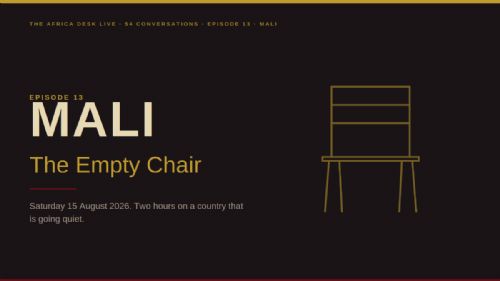
On August 15, The Africa Desk Live aired its Mali episode with no guest in the first hour. The chair was left empty on purpose.
The program had approached Malian scholars, analysts and journalists. Some declined. Most did not respond. "For weeks we read that silence as indifference, and we were wrong," the program said. A Malian scholar with family in Bamako, host Semantics King Jr. later wrote, is not being asked for an hour of her Saturday. She is being asked to let her family carry a risk that he, broadcasting from Minnesota, does not carry.
The hour instead reported the record on Malian journalism under military rule.
On August 3, a cybercrime court in Bamako sentenced Chahana Takiou, editor of the newspaper 22 Septembre, to a year in prison for criticizing the prosecution of another journalist. His lawyers sought provisional release on medical grounds, and the prosecutor refused. Youssouf Sissoko, editor-in-chief of Le Tenant, is serving two years for an article critical of military rule in neighboring Niger. Abdrahamane Kéita, who directs Le Témoin, faced trial for saying on television that the armed group JNIM controls Kidal.
Takiou and Kéita were arrested the day after the Pan-African Media Forum, a conference celebrating press freedom, closed in Bamako in June.
"Chahana Takiou edits a paper named after the day Mali became free," King said on air. "He is spending that anniversary this year in prison."
A regional method
The program described the method as regional. Governments no longer close newspapers by decree. They prosecute journalists under cybercrime laws written to deal with fraud and hacking. Mali now ranks 121st on the Reporters Without Borders index, down from 99th five years ago. Burkina Faso ranks 110th, and Niger fell 37 places in a single year.
The hour also traced Mali's long history of self-government, from the Mali Empire and the scholars of Timbuktu to the 1991 popular uprising that opened two decades of democracy. Then came 2025, when the Council of Ministers dissolved every political party and a June bill gave the head of state a renewable five-year mandate.
The government is closed. The country is not.
In the second hour, the program turned to Malian village associations in Montreuil, on the edge of Paris, which have funded water systems, schools and literacy programs in the Kayes region for decades. Remittances equal roughly four to six percent of Mali's economy, and the associations have outlasted every coup because, as the program put it, they were never asking permission in the first place.
The Africa Desk Live airs every Saturday from 10:00 AM to 12:00 PM Central on Facebook, YouTube and X, and at moremediaempowerment.org/live.