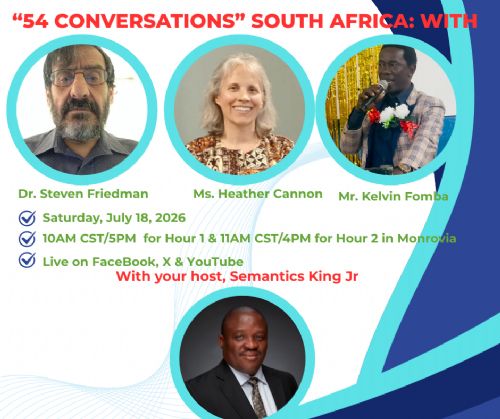
South Africa does not have a government of national unity, according to Professor Steven Friedman, research professor in the Faculty of Humanities at the University of Johannesburg. Speaking on The Africa Desk Live on July 18, he said such a government forms when a governing party facing a national crisis chooses to bring others in. What South Africa has instead, he said, is the ordinary result of a governing party losing its majority.
The label, in his reading, was a sales pitch to help President Ramaphosa persuade a reluctant ANC to govern with the Democratic Alliance. In practice, he said, the ANC and the DA together hold about 60 percent of the National Assembly and govern largely as a two-party coalition. The one genuine exception is the Inkatha Freedom Party, which matters because KwaZulu-Natal cannot be governed without it.
"For the last two years, we have had less of a government than a collection of ministries," Friedman said.
The credit nobody claims
Yet he insisted the ledger has a credit side. This is, in effect, the first government in South Africa's democratic history that knows it will lose power if it disappoints voters, and that fear produces responsiveness. He cited extortion, a problem documented for 10 to 15 years that only became a live political issue once politicians began to fear the electorate.
The credit does not reach the politicians, Friedman argued, because experts too often make decisions in office and announce them afterward, rather than leaders who stay connected to the people they serve.
A warning on the police inquiry
Friedman took what he acknowledged is a minority position on the Madlanga Commission, which has sat for more than 150 days. He argued that allegations made by a police general have not been tested as rigorously as they demand, and noted that the only people the general named were political opponents of former President Zuma.
"One of the greatest dangers to democracy anywhere in the world, ever, is unaccountable people in uniform," he said. "We need to be very careful that they are working for us and we are not working for them."
He also condemned this year's violence against other Africans in South Africa, driven by Operation Dudula and a newer movement, March and March, calling it appalling and shameful.
Friedman closed with the argument of a book he is writing. Africans have long been judged by how closely they approximate Western democracies, he said, but those democracies no longer offer a model worth copying.
"The problem is not that democracy does not work," he said. "The problem is that democracy is not being tried."
In the second hour, Heather Cannon and Kelvin Fomba, co-founders of Uniting Distant Stars, described their vocational training partnership between Minnesota and Liberia. Of the eight alumni Cannon interviewed in 2024, six were self-employed and two were employed.
The Africa Desk Live airs every Saturday from 10:00 AM to 12:00 PM Central on Facebook, YouTube and X, and at moremediaempowerment.org/live.
