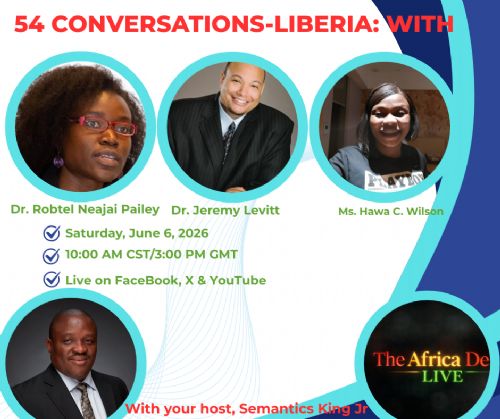
Liberia's founding motto, "the love of liberty brought us here," tells only a sliver of the country's story, Liberian academic and author Dr. Robtel Neajai Pailey argued on The Africa Desk Live on June 6. She proposed a revision, "the love of liberty united us here," which she said would hold the full range of Liberia's history, identities and people.
The episode, the fourth in MORE's 54 Conversations series, opened on a question that has followed Liberia since 1847: who belongs? For the republic's first century, Pailey said, its citizenship rules effectively barred the indigenous majority.
Progress on paper, gaps in practice
Pailey pointed to a 2022 dual citizenship law that allows Liberian women to pass citizenship to children born abroad, correcting an older statute she called sexist and patriarchal. But women hold only about 11 percent of seats in the 55th Legislature, and a 30 percent candidacy target sits in law without enforcement.
Dr. Jeremy Levitt, professor of international law at Florida A&M University and an adviser to Liberia's Truth and Reconciliation Commission, drew a straight line from impunity to harm. He described rates of sexual and gender-based violence against women that he called among the worst in the world.
"The anchor for Liberia is women," Levitt said. "If you do not protect the women, Liberia will continue to suffer."
He was blunt about outside help, arguing that foreign powers serve their own interests and that Liberians must build their own accountability mechanisms and diaspora partnerships.
The view from the neighborhoods
Hawa C. Wilson of the Paramount Young Women Initiative in Monrovia, a Mandela Washington Fellow, described her "Enough of No Excuses" project, which brings men and boys into the work against gender-based violence. The project brings together about 60 men in each community across several counties. One community chairman who first met her with scorn, she said, now logs abuse cases as a community champion.
Wilson also named an unfunded promise. A national plan reserves five percent of the education budget for girls, she said, and no government has funded it yet.
Pailey closed on structure, arguing that dependence is not a personal failing but a feature of systems that must be rebuilt. After she publicly pressed President Boakai to make the selection process for the war and economic crimes court transparent, she noted that the process was restarted with victims' groups at the table.
The Africa Desk Live airs every Saturday from 10:00 AM to 12:00 PM Central on Facebook, YouTube and X, and at moremediaempowerment.org/live.
