The chair beside the host was empty on September 19, and The Africa Desk Live said so plainly.
The program had invited Tanzanian scholars, women and men, to discuss their country 11 months after its October election. Some could not come because of family matters or travel, some did not want to be on air, and others did not answer in time. Host Semantics King Jr. told viewers he would not guess at anyone's reasons or name anyone who said no.
So he took the first hour himself, with a promise: every fact would appear on screen with its source, and he would not say anything he could not source. The question for the hour was what a country becomes after an election everyone involved knows was not won.
The vote, and who said it failed
Tundu Lissu, chairman of the main opposition party Chadema, was arrested in April 2025 and charged with treason, which carries the death penalty in Tanzania. His party was not on the ballot. In September, the presidential candidate for the second opposition party, ACT Wazalendo, was also barred. President Samia Suluhu Hassan was declared the winner with nearly 98 percent of the vote, and her party took 270 of 272 directly elected seats in parliament. She was sworn in at a military parade ground in Dodoma, with independent journalists kept out.
King stressed who found fault with the vote. It was not Washington, London or Brussels. The African Union's 72 observers, led by former Botswana president Mokgweetsi Masisi, concluded the election did not comply with AU standards, and the Southern African Development Community's mission reached a similar verdict. The chair of the AU Commission had already congratulated the winner four days before his own observers published their findings.
The dead, and the argument over how many
Young people took to the streets during and after the vote. A presidential commission chaired by retired Chief Justice Mohamed Chande Othman counted 518 dead, most from gunshot wounds, including 21 children. Nearly 2,400 people were treated in public hospitals, more than 800 of them for gunshot wounds, and 245 remain unaccounted for. Thirty-nine families say they saw the body of a loved one in a morgue, and then the body was gone.
The full report has never been made public, and Amnesty International and Human Rights Watch have called for its release. Opposition parties and religious groups say the dead number in the thousands, Western diplomats have put the figure between 1,000 and 2,000, and the commission's own chairman said his count is probably too low. A second commission, with a criminal mandate, began work in August.
"When a government investigates the conduct of its own security forces, whose account do the families believe?" King asked.
A trial, a ban and a resignation
Lissu, in custody for 17 months, was ordered by a three-judge High Court panel on August 1 to present a defense. He asked the court to summon the police chief, the army chief and the head of criminal investigations as witnesses, and the court agreed. The day before the broadcast, the criminal investigations director appeared but said he was unwilling to testify for the defense, and Lissu closed his case. Final arguments were set for the following week.
In June, the interior minister banned political rallies nationwide, and on the July 7 Saba Saba holiday, when young people had called for protests, the streets of Dar es Salaam stood empty. In August, the government suspended one of the country's most critical newspapers for six months after it reported tension at the top of government. Reporters Without Borders now ranks Tanzania 117th of 180 countries for press freedom, down 22 places in a year.
Six days after that suspension, Vice President Emmanuel Nchimbi announced he was resigning and retiring from politics. The ruling party expelled him the next day, and within days parliament approved 43-year-old Deogratius Ndejembi as Nchimbi's replacement by 324 votes to none. The government has not publicly explained why he left. King put the obvious question to viewers: was the newspaper wrong?
Zanzibar goes another way
On the islands of Zanzibar, which have their own president and parliament, the story is different. After a disputed October vote, the ruling party and ACT Wazalendo signed a joint declaration in July, launched a 10-member joint committee at State House, and, according to The Citizen, reappointed ACT leader Othman Masoud Othman as Zanzibar's first vice president. Same union, same ruling party, King said, and two different answers.
A question for the continent
In May, the United States barred a senior Tanzanian police officer from entry over what the State Department called credible information linking him to gross human rights violations against two East African activists, Boniface Mwangi of Kenya and Agather Atuhaire of Uganda.
The African Union suspends countries after coups, King noted, but has done very little when an incumbent keeps power through an election its own observers say failed. "If the only thing that counts as stealing power is soldiers in the street," he said, "then an election like this one is a model."
He closed the hour with an invitation: the chair stays open for any Tanzanian ready to sit in it.
The Minnesota hour: a community that owns its home
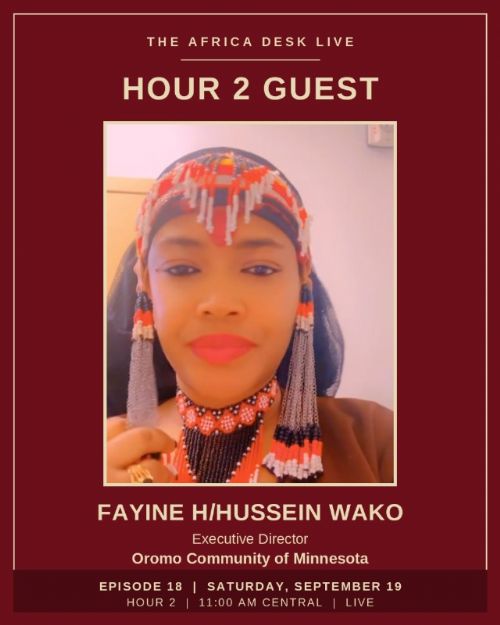
The second hour came home to St. Paul and Fayine H. Hussein Wako, executive director of the Oromo Community of Minnesota. The community began as an informal gathering of families in Minneapolis in 1985, and in 2008 it bought its own community center in St. Paul with money it raised itself, owning it outright by 2013.
Ownership is what keeps the doors open, Wako said. If they were renting and ran short, they would lose the space. Today the organization runs on a single grant. Its youth coordinator position and after-school program have ended for lack of funding, and its English classes for elders need volunteer teachers. Afaan Oromo language classes continue for children, and a cultural dance group practices in the building.
Wako described a job with no clock. Her personal phone has become the work line, weekends included, and she opens the building, fills out applications, visits elders and sometimes mops the floor. She also works a second, part-time job.
The past two years have been hard, she said, as immigration enforcement left families afraid to leave home and some members were arrested and deported. The community answered by pooling its own money to pay rent and buy food for families who could not work.
Her closing appeal was to her own community. "Unity is a power," she said, inviting every Oromo organization, church and mosque to work together under one umbrella, and inviting all Minnesotans to visit.
The Africa Desk Live airs every Saturday from 10:00 AM to 12:00 PM Central on Facebook, YouTube and X, and at moremediaempowerment.org/live. Full episodes are available on MORE's YouTube channel.